%20white%20b.png)
Captive on the Carousel of Time: A Reflection from the Artist
Updated: Apr 24
John V. Hicks Gallery Presents
Captive on the Carousel of Time
A Reflection from the Artist

I’ve always been a hopeless nostalgic.
I was insufferably sentimental growing up. I’d endlessly journal, press flowers and leaves into my books, save little notes and scraps of paper, and hang onto shells, rocks, and other special knick knacks with ferocious devotion. Even as a young child, I felt such dread when I sensed time passing (still do) and felt such a pressing need to remember everything. Maybe that’s why I ended up being sucked into painting when I started having my own children: to ponder my own childhood, and to attempt to capture theirs.
Most core memories from my kidhood and young adult life have been the most simple:
My parents surprising me with my first horse on my eighth birthday. That year, they’d moved our family of six into our machine shop they turned into a makeshift house while working to build our new one. That morning, my Dad called out to me and asked me to come into the “kitchen.” I peeked my head around the plywood wall that separated the bedrooms from the rest of our living space, and there she was- a little black pony. Lucky was her name, and she was standing right in the middle of our concrete-floored kitchen. I will always remember that, waking up to the sound of hooves in the house. It was like a dream.

Biking down Honeymoon Road as a teenager, beside which sat our farm, to watch the sun go down. Sitting on the big culverts that ran under the country road, making way for a small, shallow river to snake throughout the farmland. A river I’ve canoed many times. The sound of geese soaring above me, their bellies aflame with the orange glow of the setting sun. My husband would propose to me in that same spot at the culverts years and years later. He remembered me talking about the sunsets and the geese.
Eastertime on the farm, my mom draping the house in Ukrainian embroidery. Braiding bread, baking paska, tediously making pysanky. Her helping me cinch up the red belt on my little Poltava costume for dance competitions. The bright, floral pattern of the skirt seared itself into my mind. A “babushka” tied around my tightly braided head.

Living on a train with my sister in the summer of 2016. We played music all the way from home in Saskatchewan to Halifax and back, sometimes going three full days without ever setting foot on the ground. Singing Stan Rogers and Gordon Lightfoot and Joni Mitchell while lugging our instruments up and down the narrow hallways of the railcars. Often, travellers would request Four Strong Winds, and we would oblige happily as we cut through the Canadian wilderness: “Think I’ll go out to Alberta, weather’s good there in the fall…”

Long road trips to the foothills of the Rockies, just south of Calgary where my husband is from. Memorizing the names of the peaks, sketching them in my notebook as we drove. Taking our books and a picnic and sitting at their feet for an afternoon. Castle, Cascade, Rundle, The Three Sisters. Constant and unshakeable friends.

Laying on my back in a cemetery one night, watching the most incredible northern lights show I had ever seen. The dancing shards of green and magenta shot down into the earth like spears, passing through my chest and piercing the ground beneath me. A beauty that is completely and utterly disarming; almost alarming.

The reflex of remembering.
I think it’s a very primal feature of human nature to attempt to capture memories. Poetry, photography, painting, weaving, song, pictographs on rock. We record them all. Positive moments, meaningful moments, important moments, even tragic moments- humanity has always felt the need to immortalize them in a beautiful way. All of these tiny threads of time are what weave us into the people that we are. They make us colourful, durable. It is innate to us to want to remember.
My current exhibition at the John V. Hicks Gallery, Carousel of Time, is not only an attempt at the commemoration and preservation of my own personal memories, but also an invitation for the viewer to ponder their own. As it is my first solo show since I began painting seriously about four years ago, I wanted the work to really summarize who I am as a person, who I miss being as a child, and who I hope to be as a mother.
Very soon after I had my first baby in 2022 following an especially horrendous pregnancy where I was bedbound a lot of the time, I felt a massive surge of creative energy. The drive to create bounced off the walls of the small apartment we lived in at the time, ricocheting endlessly with nowhere to go as I was swept up in a neverending loop of feedings and diaper changes and nap traps (all of which I cherish, even so). Normally, I’d throw this energy into making music, as I grew up touring and performing with my family band (The Trudel Family), but found having a newborn wasn’t very conducive to the gig life (or even just holding a guitar for any amount of time). So, I stayed right where I was and started to paint. Once I began, I didn’t stop. My little baby lay beside me cooing on a blanket or strapped to a carrier on my back or chest. I began with simple landscapes, mostly of farmland and mountains, and eventually began venturing into more dynamic subjects such as wildlife and textiles.
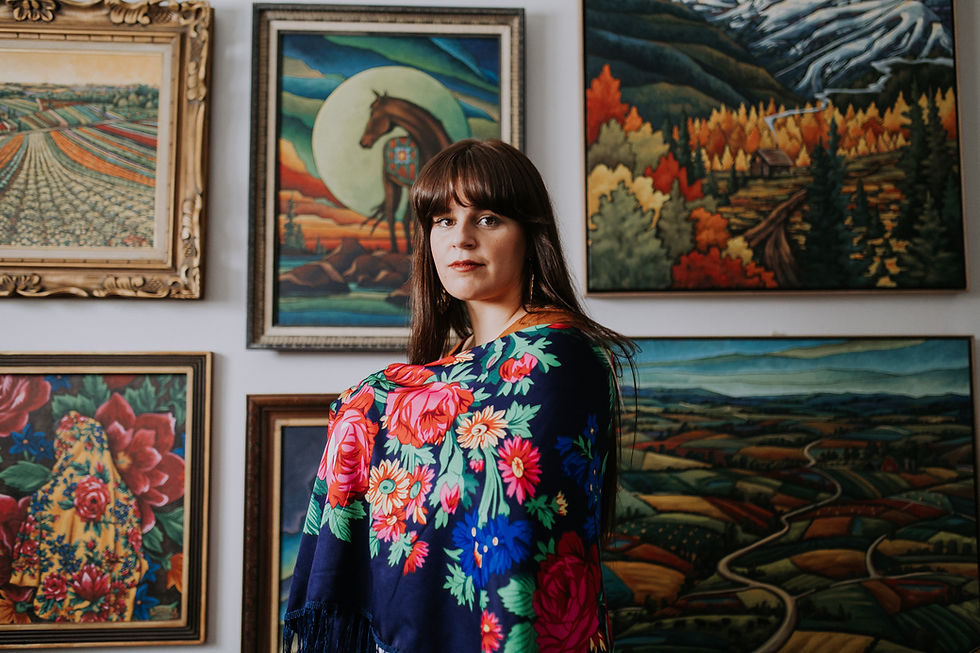
One of the textiles you may recognize appear periodically in my work is that of the “Babushka” and/or “Kokum scarf.” I’ve been fascinated with this specific pattern since I was a little kid, and it has become a strong fixation subject in my artwork. The vibrant print would appear on my cultural Ukrainian dance skirts and scarves. It would sit neatly spread out on our family table beneath loaves of paska and vases of lilies during Easter. It would fly from the hips of dancers during summers at “Back to Batoche Days” and adorn the heads of spectating elders. The bright pink roses and blue and yellow blooms could be recognized from a mile away.

The story of the scarves.
As I got older, I noticed the vivid scarves, which I always called “babushkas” and associated with Ukrainian culture, being worn proudly in the Métis, Cree, and Dene communities both around home and where I’d travel to. Even up in the remote arctic of the Territories, where my husband and I lived when I was pregnant with my first, I would see the unmistakable design worn around the heads of the older Sahtu Dene women in our community.
Once I started painting the scarves a couple years ago, it prompted me to really dive into learning more about their history and why there was such a strong use of the textile in both the Ukrainian and Indigenous communities. I found that these specific shawls were brought over by Ukrainian settlers around the 1890s and were used as a trade item between the settler and Indigenous women. The ornate scarves were given as a sign of beauty, friendship, honour, and mutual respect. Even more interestingly, the Indigenous women who received them immediately recognized the striking similarities in the bright pink flowers and viridescent foliage in the scarves to their own beadwork, which displayed similar subject matter, pallet, and intricacy. The settler women traded their scarves for the beadwork, which I can only imagine reminded them of home.
In Ukrainian culture, the scarves are typically called “Khustkas” (хустка) or even “Babushkas” (which means “grandmother” in Russian, but I’ll get to that). Following the same reasoning, the Indigenous women who received the treasured headscarves renamed them “Kokum” scarves, honouring their own matriarchs by using the Cree word for “grandmother” instead.

But what was the true genesis of these popular shawls before they reached the Indigenous women of North America? Though they were brought over to Canada by Ukrainian settlers and are most often associated with Ukrainian culture (at least where I’m from), the scarves actually originated in Russia in the village of Pavlovo (now Pavlovsky Posad) in 1975. The small manufacturing operation was eventually taken over by the founder’s grandson, who began producing the popular floral shawls we still recognize today in the 1860s. The Pavlovo Posad Manufactury still operates to this day, after nearly a century and a half.
Though the scarves are currently called by many different names, you will still hear it referred to as a “babushka,” which harkens to its Russian origin. It’s not hard to imagine how these “babushkas” swirled around the Eastern-European region and made their way to Ukraine in the mid-late 19th century, becoming an important part of their own culture and fashion. Though you’ll see the scarves worn in many different ways nowadays, they were traditionally worn exclusively by married women, who were supposed to cover their hair after they were wed. They would be tied around the head, over the ears, and secured under the chin to protect from the harsh, Slavic cold. You’ll see older Indigenous women wear them in the exact same way here in Canada, especially in the north.
The weight is in the wearer.
I’m a fiddle player and teacher, and a question I get a lot is “is there a difference between a violin and a fiddle?” The answer is yes and no. There is no difference visually or structurally, rather, the distinction is made in how you play it. I, personally, would never call myself a “violinist” or my instrument a “violin,” since I’ve played exclusively old-tyme, maritime, and Métis fiddle music for my entire life. I’m a fiddler; I play the fiddle. The difference isn’t in the instrument, it’s in the culture - the context - that it’s played in.
The same goes for the “Kokum Scarf.” Is there a difference between it and a traditional “babushka” or Ukrainian “khustka?” Again, yes and no. If you hold a traditional Ukrainian shawl up against a modern day Indigenous-made “Kokum scarf,” it is amazing how slight the differences are. I have two specifically in my possession, which you can see displayed in my Carousel of Time exhibit, which are almost identical but are likely separated by at least 50 years, I’d say. They have the same rich, blue background, woven tassels, and almost identical flower pattern. Not only do the colours of the flowers match almost perfectly, but their species and positioning on the shawl match as well. It is fascinating to me how this print has stood the test of time, crossed cultures, and still remained almost unchanged.

Unless you have obsessed over the scarves like I have in recent years, most people cannot really tell the difference between a “khustka” and a “Kokum scarf.” The floral print is just so incredibly similar. Though you will see modern “Kokum scarves” printed and sold by Indigenous vendors, it is not uncommon to also see traditional Ukrainian shawls worn by Indigenous people and called a “Kokum scarf.” That’s because there is no real, defining difference between them. They are used interchangeably by both communities. Sometimes you will even see the shawls called “Ukrainian Kokum Scarves” by different sellers, which just speaks to how inseparable each unique culture is to this iconic textile.
However, though the scarves are used interconvertably in both cultures, there are some slight distinctions in them that I’ve noticed. Perhaps the most notable is the size of the iconic floral print. In “Kokum scarves,” the print is often blown up to be much larger than the Slavic prototype, making the bright pinks, yellows, blues, and greens of the foliage the star of the show. Additionally, the most classic Ukrainian print will include delicate lines and almost lace-like designs that weave through and around the florals, which “Kokum scarves” omit. Though the flower patterns in both scarves are almost identical right down to the yellow-bordered green centres of the roses, I’ve noticed that the Ukrainian shawls will often include wheat, which I have never seen on a modern “Kokum scarf.” Wheat is very significant in Ukrainian culture, historically representing life and prosperity, and is represented not only in their shawls, but also their food, art, and flag. When making pysanky eggs or traditional paska bread at Eastertime, I always include wheat. I wonder if this symbol was eventually dropped as the pattern of the “Kokum scarf” evolved due to a difference in the value of farming (and perhaps even a lack of nostalgia for it) for Indigenous peoples. It would make sense why that particular symbol and plant, overtime and maybe even subconsciously, faded into the background.

The only other difference that I’ve noticed between the scarves (other than the fact that “khustkas” are usually made with silk or wool and modern “Kokum scarves” are often made with a cotton/polyester blend) is that “Kokum Scarves” incorporate extremely bright background colours like hot pink, neon green, and highlighter yellow. You would not typically see these specific colours in the traditional Ukrainian shawls, though they’ve become more common in recent productions of the textile (which just further blurs the line between the two, which I think is cool). Typically, you’ll see the “khustka” incorporate tones that are bold but not overly bright: cobalt blue, emerald green, ruby red, royal purple, pastel yellow, black, and white.
The difference is in the wearer, the culture they’re in, their heritage and intention. When it comes down to it, though, there is no true, surefire difference. Though there are “Kokum scarves” being made today with the slight differences and updates that I mentioned above, you can still go to Ukraine and see a baba wearing the exact same scarf as a Kokum, Nohkom, or Mémère here in Canada.

A Solidarity-Driven Renaissance.
A few years back, I started to notice what seemed to be a strong resurgence of the “Kokum Scarf” in my home town and beyond. It was everywhere you turned, appearing on ballcaps, scrunchies, ribbon skirts, car seat covers, and even umbrellas. It seemed like the pattern wasn’t reserved for elders anymore, but was worn by everyone, young and old. I wondered what prompted this strong revival of the print, or if I had imagined it.
It was 2022 when I started to notice this renaissance of the “Kokum Scarf.” It was also the year I moved home to Prince Albert from the arctic, the year I had my first baby, and, coincidentally, the year Russia invaded Ukraine.
Though the Russo-Ukrainian War has now been going on for over twelve years, it was in February of 2022 when Putin launched the full-scale assault on the Ukrainian people that they have been tormented by ever since. It was this attack that prompted the Indigenous peoples of Canada to take up their “Khustkas” or “Kokum Scarves” and wear them in solidarity with the Ukrainian people, who were now being stripped of their land. It goes without saying that this is a feeling our First People know all too well; a trauma that has mercilessly reverberated through their bones for generations.
I don’t think I need to spell the poetry and irony of this, but I”ll try: A vibrant, floral scarf of Russian origin. An Indigenous community wearing it to show solidarity to those who first introduced the pattern to them so many generations ago - the Ukrainian people - who are now being oppressed by the scarves’ original homeland. Now that’s a full-circle moment.
I’ve read some opinions online that think the “babushka” scarves should be boycotted due to their origin. I ferociously disagree. When art is made, it takes on a life of its own. It grows arms and legs, communicating with and impacting people and cultures far beyond the scope (or capacity, for that matter) of the artist who created it. In this case, that artist was Ivan Dmitrievich Labzin, founder of the original Pavlovo Posad Shawl Manufactory in Russia. Now, at least in Canada, the scarves are used as a symbol of solidarity and resistance toward their own homeland. Art is like that. The Ukrainian people adopted it and wore it proudly for before they ever arrived here, and the Indigenous women of the prairies saw the beauty and familiarity in the beautiful design and made it their own. It remains, as it has always been in Canada, a symbol of lasting friendship, pride, resilience, and solidarity between both communities.

Anyways, that’s a bit on the shawls. I thought it important to go a bit into the history of the scarves since they appear in my work, however, I am not an expert in the slightest, and only share what I have learned through my own observation and research. I love the scarves, always have, and feel such a joy and reverence when immortalizing them, in my own small way, through my work.
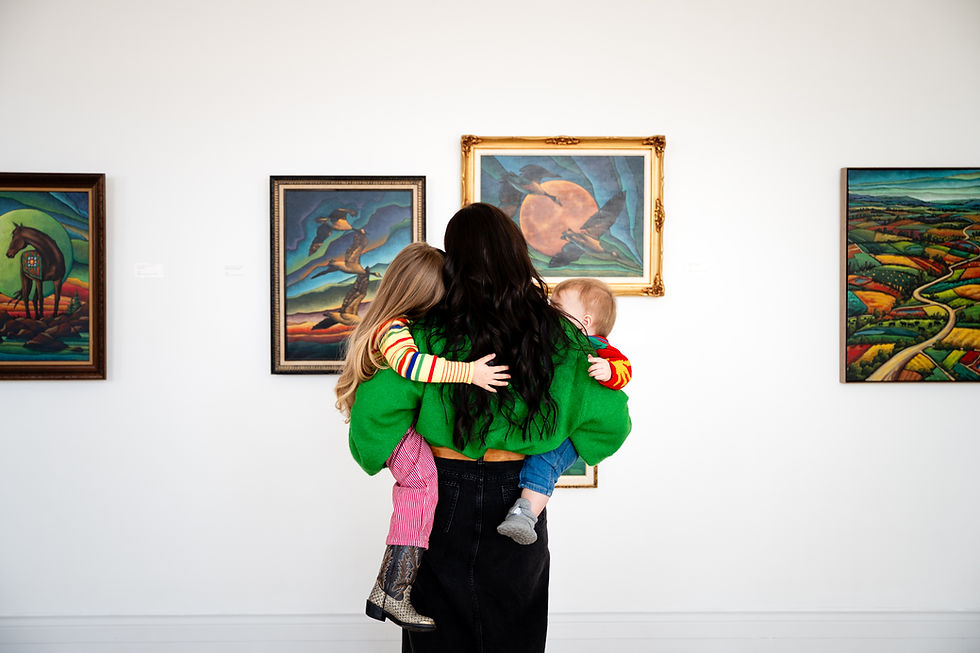
Surrounded by the scarf display at the gallery is the rest of my collection. You’ll see a horse draped in a star blanket, patchwork farmland, migrating geese, vibrant mountains, northern lights, trains, and, obviously, some figures draped in “Kokum scarves.” I painted all fifteen pieces in six months, with my two young kids tugging at my pant legs. It has been such an honour to show my work at the John V. Hicks Gallery in this my first solo exhibition, and I’ve found such comfort in creating these nostalgia-soaked pieces.
I hope that, if you visit the gallery, you’ll be reminded of some cherished memory of your own: a special farm from your childhood, a memorable aurora show, an animal you loved as a child, a homeland you left a long while ago, a grandmother you miss. Without a doubt, there is a deep comfort in reminiscing, but there can also be a strong sorrow, either because the past itself was painful, or because it pains you to know you can never go back to it. Joni Mitchel said it best in her song The Circle Game, after which I named this exhibition, and which I will leave you with now:
And the seasons they go round and round
And the painted ponies go up and down
We're captive on the carousel of time
We can't return we can only look behind
From where we came
And go round and round and round
In the circle game

Janaya McCallum
Visual Artist, Prince Albert, SK.


A few days ago I was watching an Canadian stream where viewers were discussing different casino-style platforms, and one of the comments included Grey Rock Casino . That caught my attention because I like trying new sites when I have free time. I opened it in the evening and started exploring different slots without any expectations. The interface felt simple enough that I didn’t waste time figuring things out. At first my results were mixed, but after switching games I had a short streak that made the session more interesting.