%20white%20b.png)
The Idea of North: A Permanent Collection Exhibition
April 16 – June 6, 2026
Mann Art Gallery

What does it mean to experience the North, not just as a place, but as a feeling, a memory, and a way of seeing? The Idea of North, the Mann Art Gallery’s current Permanent Collection exhibition, invites visitors into this question through a rich gathering of works that reflect the depth, complexity, and beauty of northern Saskatchewan.
Inspired in part by Joe Fafard’s iconic bronze wolf Mahihkan, installed at the gallery in 2016, the exhibition takes its cue from the artist’s vision of harmony between humans, animals, and the natural world. From this starting point, The Idea of North unfolds as a multi-layered exploration of how artists across generations have interpreted and responded to the landscapes, histories, and lived experiences of the North.
A Landscape of Experience
For many, the North is imagined through its landscapes, expansive boreal forests, glacial lakes, and the rugged terrain of the Canadian Shield. These elements are vividly present in the exhibition, yet they are far from static backdrops. Instead, they become active, expressive forces shaped by memory, movement, and emotion.

In Rocks on the South Side of Island (2009), Greg Hardy captures the sensory immediacy of Lac La Ronge. Working from sketches made while kayaking, Hardy distills the rhythm of water, rock, and forest into gestural charcoal and pastel marks. His work conveys not just what the land looks like, but what it feels like to move through it, its textures, its energy, and its quiet intensity.
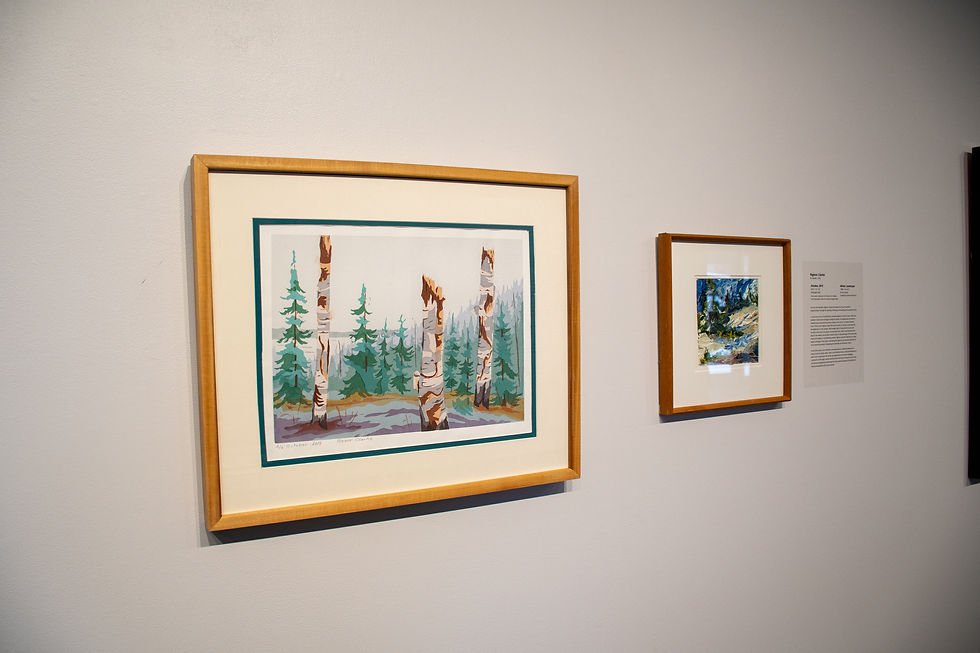
Similarly rooted in direct experience, Rigmor Clarke’s practice spans over five decades of immersion in Saskatchewan’s wilderness. Whether through her intimate oil paintings like Winter Landscape (1988) or her print works, Clarke translates on-site sketches into expansive compositions that balance immediacy with reflection. Her work speaks to a deep, spiritual connection with the land, one shaped by time, observation, and reverence.
Changing Environments, Urgent Realities
While some works celebrate the enduring beauty of the North, others confront its fragility in the face of environmental change.

Donna Stockdale’s Eli’s Coming (2016), created through wet-felted merino wool, depicts the devastating 2015 wildfire near La Ronge. The softness of the material contrasts sharply with the intensity of the subject: a wall of fire overtaking a vibrant landscape. This tension underscores the unpredictability of nature and the growing impact of climate-related events in northern communities.
Ken van Rees approaches a similar subject from a different angle. In Burnt Forest Revival, Davin Lake (2012), his background as a forest soil scientist informs an experimental process of mark-making. By pressing paper against charred trees, van Rees allows the landscape itself to leave its imprint. The result is an abstract yet deeply physical record of destruction and regeneration; an embodiment of the boreal forest’s cyclical nature.
Cultural Knowledge and Personal Histories
The exhibition also highlights how the North is understood through cultural identity, memory, and storytelling.

Bob Boyer’s works, including Prayer Tree (1995) and Pines of Home When I Am Dancing (1996), reflect a profound engagement with Indigenous philosophies and lived experience. Drawing on Plains Cree and Sioux traditions, Boyer’s later works emphasize healing, balance, and interconnectedness. His use of symbolic imagery—mountains, trees, celestial forms—creates visual narratives that bridge personal history with broader cultural knowledge.
This sense of place as lived and remembered extends across the collection. Artists like Kay Bould, who began her practice in early 20th-century Saskatchewan, and J.S. Base, whose work was shaped by early artistic communities around Emma Lake, contribute to a historical continuum of artistic engagement with the region. Their works sit alongside those of later artists such as Adrian Vinish, Margreet van Walsem, Rose Mineau, and Connie Freedy, each offering distinct perspectives shaped by their own relationships to land, community, and creative practice.
Ernest Lindner’s Fairy Island stands as another cornerstone of this legacy. Known for his intricate depictions of forest ecosystems, Lindner’s work reflects a lifelong fascination with cycles of growth and decay. His studio at Emma Lake—built by hand and surrounded by dense boreal forest—served as both sanctuary and source, grounding his artistic vision in careful observation of the natural world.

Expanding the Narrative
Since the establishment of the Mann Art Gallery’s Permanent Collection in 1993, the collection has grown to reflect a broader and more inclusive understanding of northern experience. While earlier works often aligned with romanticized landscape traditions, recent acquisitions expand the narrative to include diverse media, voices, and perspectives.
Textiles, printmaking, painting, and experimental processes all find space within The Idea of North, demonstrating that the North cannot be defined by a single image or story. Instead, it emerges as a dynamic interplay of environment, culture, and identity, continually reshaped by those who live, work, and create within it.
An Invitation to Reflect
The Idea of North is not a fixed definition, but an open question. Through these works, visitors are encouraged to consider their own relationships to place: How do we understand the land around us? What stories do we carry with us? And how do these experiences shape our sense of belonging?
As both a record of artistic practice and a reflection of regional identity, the exhibition underscores the vital role of the Permanent Collection in preserving and sharing these stories. It is through the generosity of donors and the ongoing support of the community that the Mann Art Gallery continues to build a collection that speaks to the past, present, and future of northern Saskatchewan.
We invite you to experience The Idea of North, to move through its landscapes, reflect on its histories, and discover new ways of seeing the North.

Choosing an online gaming club in Canada can be surprisingly difficult because many platforms appear almost identical at first glance. However, after spending some time comparing them, differences quickly become visible in areas like customer support quality, payment processing, and platform stability. Personally, I prefer gaming clubs that create a calm and intuitive environment without relying too heavily on aggressive advertising tactics. During a recent conversation with friends who regularly play online, Casino Wolinak was mentioned as a platform that several users considered dependable and easy to navigate. I also appreciate when a gaming club explains its policies clearly and avoids unnecessary complexity in account management. In my experience, platforms that prioritize user comfort and transparency tend to build much…